
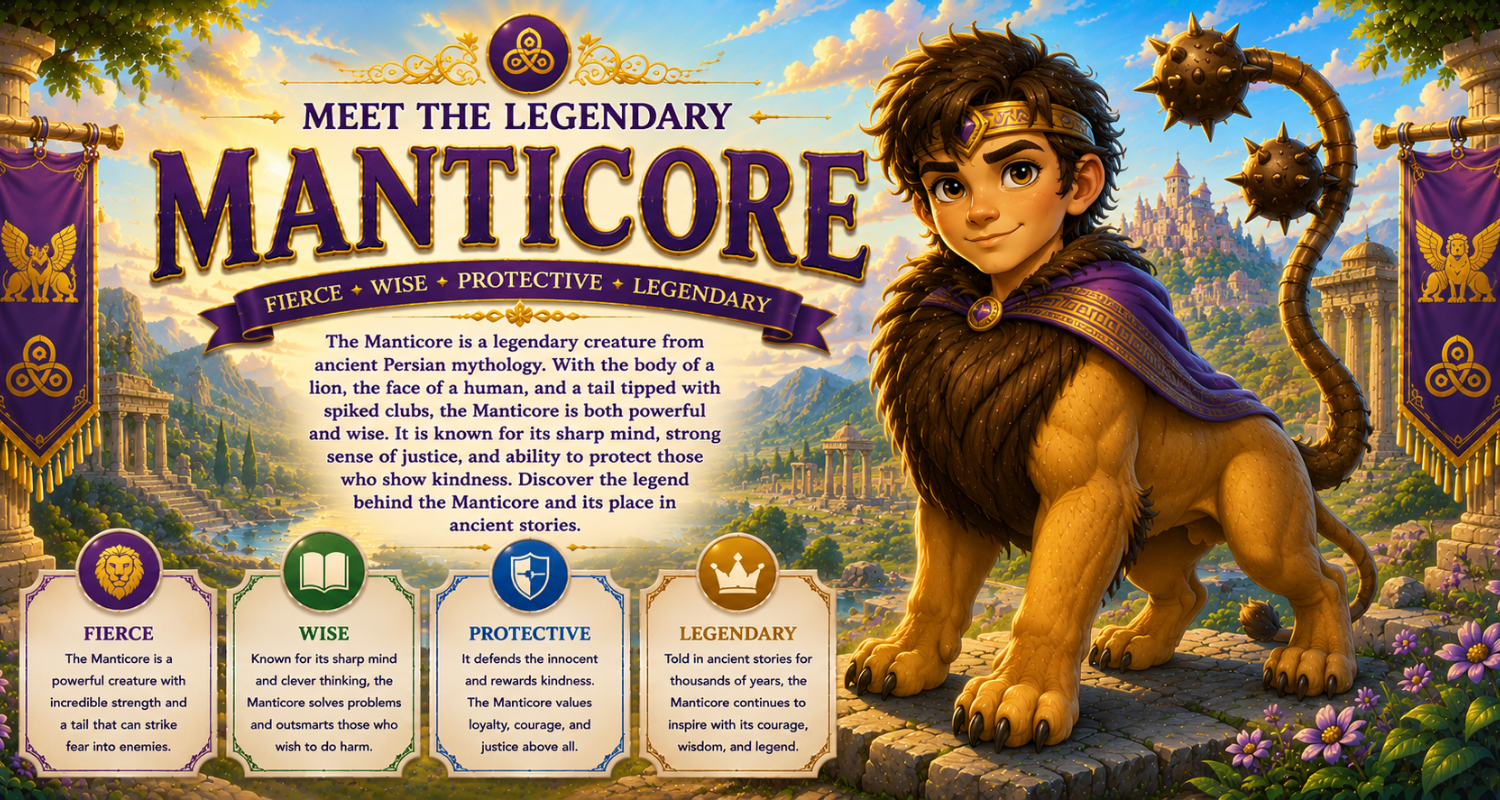
Meet the Legendary Manticore — Fierce, Wise, Protective, Legendary hero banner

Manticore: Facts, Powers, Legends, and Mythology

Guide

What Is a Manticore?

A Manticore is a legendary hybrid creature with the body of a lion, the head of a human, and the tail of a scorpion. First appearing in ancient Persian mythology, it later spread into Greek legend and medieval European bestiaries — becoming one of the most recognizable monsters in world folklore.

The name Manticore comes from the Persian phrase martiya khvara, meaning "man-eater." Although its reputation is fearsome, the Manticore's human face also symbolizes intelligence, cunning, and the mysteries of the unknown.

Today, Manticores appear in fantasy novels, role-playing games, movies, and video games — from Harry Potter to Dungeons & Dragons — often portrayed as powerful guardians or fierce beasts with magical abilities.

The Manticore stands alongside the griffin, the chimera, and the sphinx as one of mythology's greatest hybrid creatures. Explore the full mythical creatures guide to discover more.

Quick Manticore Facts

Creature Type

Mythical Hybrid Monster

Appearance

Lion's Body, Human Head, Scorpion Tail

Origin

Ancient Persian Mythology

Habitat

Deserts, Mountains, Forests

Powers

Super Strength, Venomous Tail, Powerful Roar

Symbolism

Danger, Mystery, Courage

Appearance

What Does a Manticore Look Like?

The Manticore combines features from three different creatures into one unforgettable appearance — the strength of a lion, the intelligence of a human, and the deadly weapons of a scorpion.

Human Head

Unlike most mythical beasts, the Manticore has the face of a human — often depicted with intelligent eyes and expressive features that emphasize both strength and cunning.

Lion's Body

The muscular body of a lion gives the Manticore incredible speed, power, and endurance — symbolizing courage and dominance in ancient myth.

Scorpion Tail

Long and curved like a scorpion's, the Manticore's tail is said to carry deadly venom or launch poisonous spikes, making the creature truly fearsome.

Sharp Teeth

Stories describe several rows of razor-sharp teeth, reinforcing the Manticore's reputation as one of mythology's most dangerous predators.

Powerful Claws

Strong lion claws allow the Manticore to climb, hunt, and defend itself with remarkable skill — perfect for a wilderness predator.

Hybrid Form

Combining three creatures into one, the Manticore is one of mythology's most recognizable and unforgettable hybrid monsters.

Golden Manticore

Golden fur reflects the lion's majestic appearance and symbolizes power and royalty.

Brown Manticore

Brown Manticores resemble real lions and appear often in traditional artwork and fantasy illustrations.

Black Manticore

Modern fantasy often portrays black Manticores as mysterious creatures connected to ancient magic and forgotten ruins.

Red Manticore

Some fantasy stories depict Manticores with deep red fur or glowing red markings to emphasize their magical and dangerous nature.

How Big Is a Manticore?

Most legends describe the Manticore as slightly larger than a full-grown lion — standing 5 to 6 feet (1.5–1.8 meters) tall at the shoulder and measuring 10 to 12 feet (3–3.7 meters) from head to tail.

Powers

Manticore Powers

The Manticore is one of mythology's most dangerous hybrid creatures, combining the strength of a lion, the intelligence of a human, and the deadly weapons of a scorpion.

Incredible Strength

The Manticore's powerful lion body lets it overpower large animals and even bring down prey much larger than itself.

Venomous Tail

Its scorpion-like tail carries deadly venom — and in some legends launches poisonous spikes at enemies from a distance.

Fearsome Roar

The Manticore's roar is said to be loud enough to terrify entire armies and echo across deserts and mountains.

Keen Senses

Lion-sharp hearing, eyesight, and smell help the Manticore locate prey from great distances and detect approaching threats.

Human Intelligence

Unlike ordinary beasts, the Manticore's human face symbolizes cunning, strategy, and the ability to outwit its enemies.

Great Speed

Despite its large size, the Manticore is surprisingly fast — sprinting across deserts, forests, and mountains with ease.

Mythology

Manticore Mythology

From ancient Persia to medieval Europe and modern fantasy, the Manticore has fascinated storytellers for more than two thousand years.

Ancient Persia

The earliest Manticore legends come from ancient Persia (modern-day Iran), where its name meant 'man-eater' and it was feared as a dangerous predator.

Greek Historians

Greek physician and historian Ctesias recorded Persian stories about the Manticore, introducing the creature to the wider Mediterranean world.

Medieval Bestiaries

During the Middle Ages, the Manticore became one of Europe's best-known beasts — appearing in illustrated bestiaries alongside dragons, griffins, and unicorns.

Symbolic Monster

Medieval writers used the Manticore as a symbol of hidden danger, deception, and the challenges heroes must overcome through courage and wisdom.

Knights & Quests

Stories often placed Manticores in distant wilderness regions where brave knights and adventurers encountered them during dangerous quests.

Modern Fantasy

Today the Manticore appears in books, films, and games — from Harry Potter to Dungeons & Dragons — as powerful guardians or fierce magical beasts.

Persian Roots

The name comes from the Persian phrase 'martiya khvara' meaning 'man-eater,' later adapted by Greeks into 'mantichoras.'

Cultural Spread

From Persia to Greece to medieval Europe and beyond, the Manticore has fascinated storytellers for more than two thousand years.

The Mystery of the Human Face

The Manticore's most striking feature isn't its claws or its venomous tail — it's the human face. Medieval artists often gave it calm, almost friendly expressions, creating a striking contrast with its fierce body and reminding readers that danger does not always appear frightening at first glance.

Today, fantasy stories still use the Manticore's human face to represent wisdom, mystery, and unpredictability — combining familiar human features with the fearsome characteristics of powerful wild animals.

Home & Symbolism

Where the Manticore Lives & What It Means

Manticore Habitat

Deserts

Vast Persian deserts are the Manticore's earliest legendary home — wide, hot, and dangerous landscapes perfect for a fearsome predator.

Mountains

Rocky peaks and hidden caves provide shelter and the high ground a hunter like the Manticore needs to ambush prey.

Forests

Dense woodlands and thick undergrowth became favorite settings for medieval Manticore stories featuring brave knights.

Ancient Wilderness

Above all, the Manticore belongs to wild places untouched by civilization — landscapes of mystery and adventure.

Symbolism

Danger

The Manticore is one of mythology's most iconic symbols of hidden danger and the wild forces of the untamed world.

Mystery

Its strange hybrid form represents the unknown — distant lands, ancient secrets, and the wonders waiting beyond the map.

Courage

Facing a Manticore in legend required heroic courage, making the creature a powerful symbol of bravery and resolve.

Intelligence

The human face reminds readers that the greatest dangers often combine raw strength with clever, calculating thought.

Survival

With its powerful body, venomous tail, and keen senses, the Manticore symbolizes resilience under the harshest conditions.

Facing Fear

In myth and modern fantasy alike, the Manticore stands for the fears that heroes must confront in order to grow.

Legendary

Famous Manticores

From the ancient writings of Ctesias and medieval bestiaries to Harry Potter, Dungeons & Dragons, and Percy Jackson — the Manticore has inspired storytellers for thousands of years.

Ctesias' Manticore

The earliest detailed description, recorded by the Greek historian Ctesias after he heard Persian travelers' tales of the beast.

Medieval Bestiary Manticores

Illustrated medieval manuscripts featured detailed Manticore drawings as warnings of hidden danger and moral lessons.

Harry Potter Manticore

J.K. Rowling's wizarding world includes the Manticore as a dangerous magical beast with deadly venom and a near-impenetrable hide.

Dungeons & Dragons

A classic D&D monster, the Manticore is famous for hurling iron-like spikes from its tail at adventurers from a distance.

Final Fantasy

Several Final Fantasy games feature Manticore-inspired enemies that combine speed, strength, and powerful magical abilities.

Magic: The Gathering

The trading card game includes multiple Manticore creatures known for their ferocity and powerful battle abilities.

Percy Jackson

Rick Riordan's series features a menacing Manticore named Dr. Thorn, blending Greek and Persian mythology into modern adventure.

Fantasy Guardians

Across modern fantasy, Manticores often appear as apex predators or magical guardians watching over ancient ruins and hidden treasures.

For Kids

Fun Manticore Facts

  • 1Manticores have the body of a lion.
  • 2They have the head of a human.
  • 3Their tail looks like a scorpion's.
  • 4Manticores first appeared in Persian mythology.
  • 5They became famous throughout Europe during the Middle Ages.
  • 6The name 'Manticore' means 'man-eater.'
  • 7They are described as larger than a real lion.
  • 8Some legends say their tail launches poisonous spikes.
  • 9Manticores have rows of razor-sharp teeth.
  • 10Greek historian Ctesias was the first to write about them.
  • 11Medieval bestiaries often featured Manticores.
  • 12Manticores can be golden, brown, black, or red in stories.
  • 13They are about 10 to 12 feet long from head to tail.
  • 14Their roar is said to be loud enough to scare armies.
  • 15Manticores live in deserts, forests, and mountains.
  • 16Most legends describe them as solitary hunters.
  • 17Some fantasy stories give Manticores wings.
  • 18They appear in Harry Potter and Dungeons & Dragons.
  • 19Percy Jackson features a Manticore named Dr. Thorn.
  • 20The human face symbolizes intelligence and cunning.
  • 21Manticores symbolize danger, mystery, and courage.
  • 22They are one of mythology's most famous hybrid creatures.
  • 23No scientific evidence proves Manticores ever existed.
  • 24They have inspired stories for over two thousand years.
  • 25Manticores remain a favorite in modern fantasy worlds.

FAQ

Frequently Asked Questions

SevenCreatures logo

Reviewed by Sevyn's Creature Team

SevenCreatures creates fun, kid-friendly educational content about animals, dinosaurs, sea creatures, and mythical creatures. Our mission is to help kids explore the amazing creatures of our world through facts, quizzes, coloring pages, and stories.