
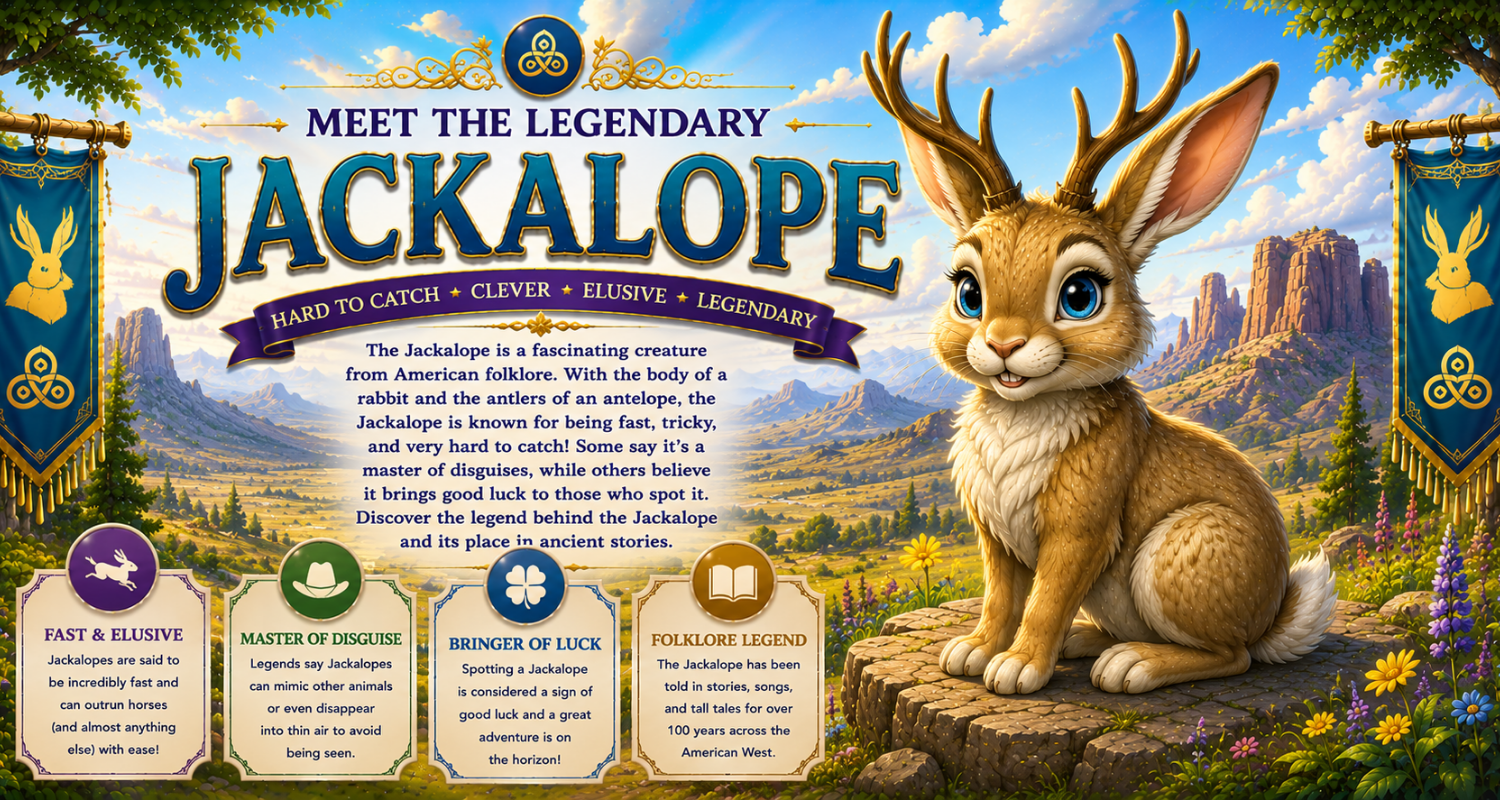
Meet the Legendary Jackalope — American folklore horned rabbit hero banner

Jackalope: Facts, Powers, Legends, and Mythology

Guide

What Is a Jackalope?

The Jackalope is a legendary creature from American folklore that combines the body of a jackrabbit with the antlers of an antelope or deer. Although no real Jackalope has ever been discovered, stories about this clever, fast-moving creature have entertained families for generations.

Jackalope legends became especially popular in the western United States during the early 1900s. Travelers, ranchers, and storytellers shared tales about Jackalopes racing across deserts and prairies while cleverly avoiding anyone who tried to catch them.

Unlike many mythical creatures, the Jackalope is usually portrayed as playful rather than dangerous. Its legend celebrates creativity, humor, and the adventurous spirit of the American frontier.

The Jackalope stands alongside the kitsune, the unicorn, and the griffin as one of folklore's most beloved creatures. Explore the full mythical creatures guide to discover more.

Quick Jackalope Facts

Creature Type

Mythical Hybrid Animal

Appearance

Rabbit with Antelope-Like Antlers

Origin

American Folklore

Habitat

Prairies, Forests, Deserts

Powers

Incredible Speed, Sharp Hearing, Cleverness

Symbolism

Adventure, Humor, Imagination

Appearance

What Does a Jackalope Look Like?

The Jackalope looks almost exactly like a jackrabbit — except for one extraordinary feature: its antlers. This unusual combination of familiar and fantastic features makes it instantly recognizable.

Rabbit Body

Most of the Jackalope's body resembles a wild jackrabbit — soft fur, long legs, and a compact build built for speed and agility.

Antlers

The Jackalope's antlers are its most famous feature. They may resemble deer antlers or antelope horns, making the creature unlike any real animal.

Long Ears

Like ordinary rabbits, Jackalopes have long ears that detect sounds from great distances and make them hard to surprise.

Powerful Hind Legs

Muscular back legs allow the Jackalope to leap great distances and sprint at incredible speeds across open grasslands and deserts.

Soft Fur

Thick fur protects the Jackalope from changing weather and helps it blend into prairies, woodlands, and rocky landscapes.

Compact Frame

A small, lightweight body lets the Jackalope dart between sagebrush, cactus, and rocks with surprising agility.

Brown Jackalope

The most common color — closely matches real jackrabbits found across western North America.

Gray Jackalope

Gray Jackalopes blend perfectly into rocky hillsides, sagebrush, and dry grasslands.

White Jackalope

Rare legends describe white Jackalopes living in snowy mountains or appearing as especially magical creatures.

Black Jackalope

Black Jackalopes appear in modern fantasy stories as mysterious nighttime creatures.

How Big Is a Jackalope?

Most legends describe the Jackalope as about the same size as a large jackrabbit — standing 1 to 2 feet (30–60 centimeters) tall and weighing 5 to 15 pounds (2–7 kilograms). Its antlers add several inches of height, making it appear more impressive than an ordinary rabbit while still quick enough to escape almost any pursuer.

Powers

Jackalope Powers

The Jackalope may not breathe fire or cast spells, but American folklore gives this legendary creature lightning speed, sharp senses, and clever survival skills.

Incredible Speed

Jackalopes are said to sprint so fast across prairies that even skilled riders on horseback cannot catch them.

Powerful Jumping

Strong hind legs let the Jackalope clear fences, streams, and bushes — some tales say even wagons in a single bound.

Sharp Hearing

Long ears give the Jackalope extraordinary hearing, helping it detect danger from great distances.

Cleverness

Western tall tales describe Jackalopes as exceptionally clever — even imitating human voices around cowboy campfires.

Natural Camouflage

Its fur matches grasslands, deserts, and forests, making the Jackalope nearly invisible while resting or hiding.

Survival Skills

Jackalopes are expert survivors — finding food, avoiding predators, and thriving in the harsh landscapes of the American West.

Mythology

Jackalope Mythology Around the World

From Wyoming taxidermy and Western tall tales to Bavarian Wolpertingers and European horned hares, the Jackalope is part of a worldwide tradition of legendary hybrid animals.

American Folklore Origins

The Jackalope became popular through humorous frontier stories shared by ranchers, hunters, and travelers across the American West.

Western Tall Tales

Jackalopes became regular characters in Western tall tales — nearly impossible to catch and rumored to mimic the voices of cowboys.

Wyoming, Home of the Jackalope

Wyoming is called the 'Home of the Jackalope.' The town of Douglas celebrates the creature with statues, festivals, and beloved local traditions.

The Herrick Brothers

In the 1930s, Wyoming taxidermists Douglas and Ralph Herrick created novelty mounts by attaching antlers to jackrabbits — sparking the modern legend.

Native American Influences

Older Indigenous stories include unusual horned animals and spiritually significant wildlife, showing imaginative animal legends existed long before the Jackalope.

European Horned Hares

For centuries, European artwork depicted rabbits with horns — possibly inspired by infected rabbits or simply by imagination.

The Wolpertinger Connection

Germany's mythical Wolpertinger, a Bavarian creature blending parts of several animals, shares the Jackalope's playful hybrid spirit.

Modern Mythology

Today Jackalopes appear in books, cartoons, video games, and family movies — keeping the legend alive for new generations.

Why Does the Jackalope Have Antlers?

Its antlers are the defining feature of the Jackalope legend, combining a jackrabbit with an antelope or deer to create a creature unlike any real animal. The name itself blends jackrabbit and antelope.

Scientists believe some older stories may have been inspired by real rabbits infected with the Shope papilloma virus, a condition that can produce horn-like growths on a rabbit's head. Although these growths are not true antlers, they may have helped convince some people that horned rabbits really existed.

Home & Symbolism

Where Jackalopes Live & What They Mean

Jackalope Habitat

Grasslands

Tall grasses give the Jackalope cover and open terrain to use its legendary speed.

Forests

Woodlands offer shelter under trees and plenty of berries and plants to forage.

Deserts

Sagebrush, cactus, and rocky hills feature in Western tall tales of racing Jackalopes.

Open Plains

The vast plains of the American West symbolize freedom and adventure — ideal Jackalope country.

Symbolism

Imagination

By combining familiar animals into something new, the Jackalope celebrates the power of imagination.

Adventure

Jackalope legends are tied to the open frontier and the excitement of discovering wonders in the natural world.

Humor

Unlike many legendary monsters, the Jackalope is known for making people smile through playful tall tales.

Nature

The Jackalope celebrates the beauty of America's grasslands, deserts, forests, and wide-open spaces.

Curiosity

The mystery around the creature inspires people to keep asking how such an unusual animal became so famous.

American Folklore

Above all, the Jackalope represents the creativity, optimism, and storytelling spirit of the American West.

Legendary

Famous Jackalopes in Stories & Culture

From Douglas, Wyoming and Western roadside attractions to Red Dead Redemption and children's books — the Jackalope has inspired storytellers for nearly a century.

The Original Wyoming Jackalope

The first famous Jackalope mounts came from Douglas, Wyoming in the 1930s, created by taxidermists Douglas and Ralph Herrick.

Douglas, Wyoming — Jackalope Capital

Douglas proudly calls itself the 'Jackalope Capital of the World,' with giant statues, festivals, and Jackalope souvenirs everywhere.

Roadside Attractions

Taxidermy Jackalopes became iconic roadside attractions across the American West, inspiring postcards and gift shops for generations.

Red Dead Redemption

The Red Dead Redemption video game series includes Jackalope-inspired animals, letting players encounter the famous folklore creature.

America: The Motion Picture

This animated comedy features the Jackalope as part of its humorous reimagining of American legends.

Children's Books

Jackalopes star in countless children's books as clever, adventurous, and friendly woodland animals that spark imagination.

Frontier Tall Tales

Cowboys and ranchers told stories of Jackalopes that could sing along to campfire songs — pure Western humor at its best.

Wolpertinger of Bavaria

Germany's Wolpertinger — a hybrid creature blending several woodland animals — is the Jackalope's closest European cousin.

For Kids

Fun Jackalope Facts

  • 1Jackalopes are rabbits with antlers.
  • 2They come from American folklore.
  • 3Wyoming is famous for Jackalope stories.
  • 4Jackalopes are known for being very fast.
  • 5No real Jackalope has ever been found.
  • 6They are mythical hybrid animals.
  • 7Their name combines 'jackrabbit' and 'antelope.'
  • 8Most stories take place in the American West.
  • 9Jackalopes have powerful back legs.
  • 10They can make enormous jumps.
  • 11Their ears have excellent hearing.
  • 12They are experts at hiding.
  • 13Some legends say they imitate human voices.
  • 14They are usually friendly rather than dangerous.
  • 15They enjoy wide-open grasslands.
  • 16Douglas, Wyoming celebrates the Jackalope.
  • 17Jackalopes appear in children's books.
  • 18They are popular roadside attractions.
  • 19They symbolize imagination.
  • 20They also represent adventure.
  • 21Some stories say they only appear at night.
  • 22Their antlers make them easy to recognize.
  • 23They are among America's newest mythical creatures.
  • 24They remain popular throughout North America.
  • 25Jackalopes remind us that great stories begin with imagination.

FAQ

Frequently Asked Questions

SevenCreatures logo

Reviewed by Sevyn's Creature Team

SevenCreatures creates fun, kid-friendly educational content about animals, dinosaurs, sea creatures, and mythical creatures. Our mission is to help kids explore the amazing creatures of our world through facts, quizzes, coloring pages, and stories.