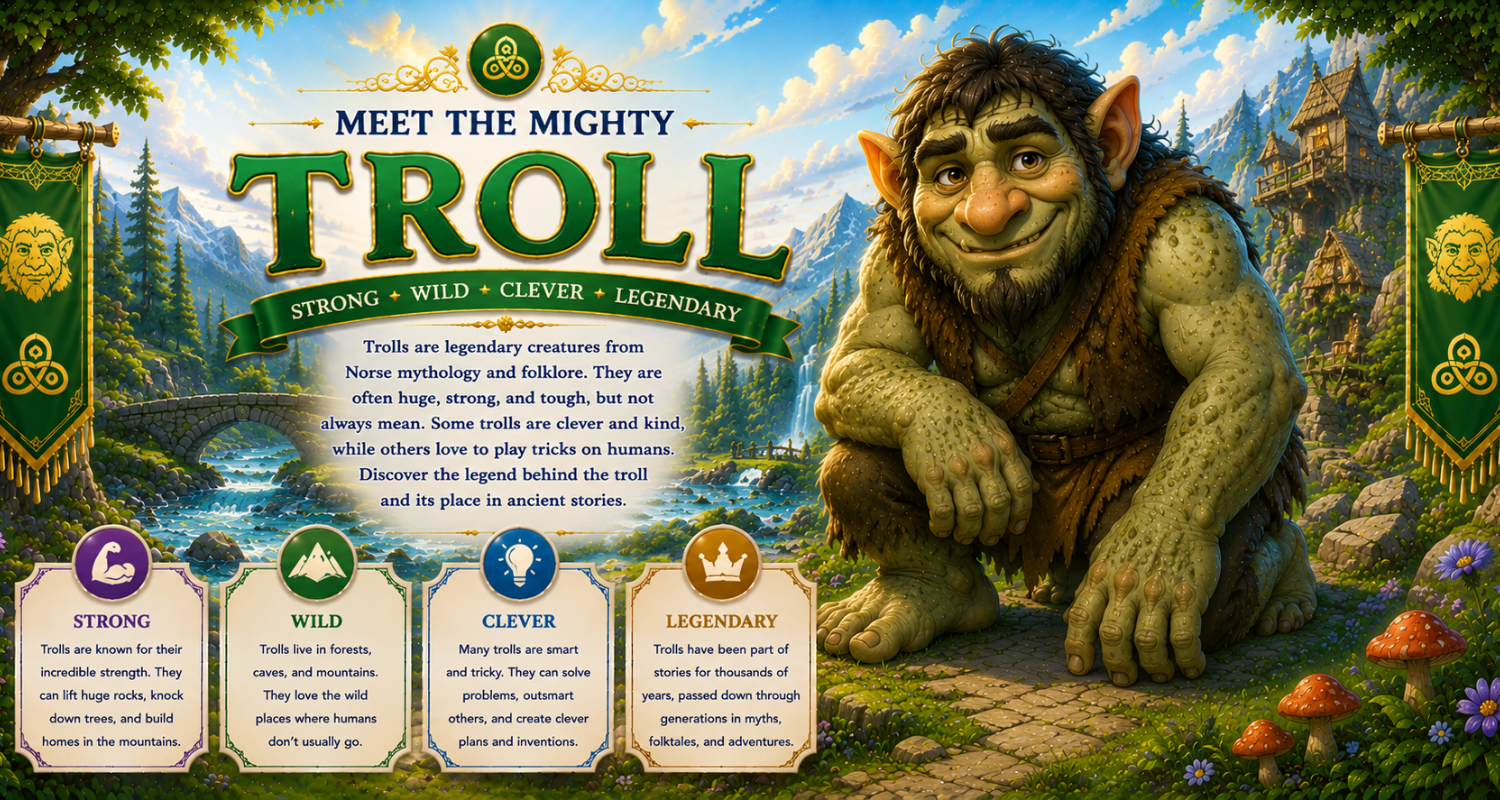
Meet the Mighty Troll — Norse and Scandinavian folklore hero banner

Troll: Facts, Powers, Legends, and Mythology

Guide

What Is a Troll?

A Troll is a legendary creature from Norse and Scandinavian folklore. Depending on the story, a troll may be a towering giant, a mountain-dwelling monster, or a magical nature spirit living deep within forests and caves.

Trolls have appeared in Scandinavian legends for over a thousand years. Early stories often described them as ancient beings connected to rocks, mountains, and wilderness. Some trolls were dangerous and disliked humans, while others simply preferred to be left alone in the wild.

One of the best-known beliefs says that trolls turn to stone if caught in the sunlight — a legend inspired by the many unusual rock formations found throughout Norway and Sweden. Modern fantasy has introduced many new versions, but traditional folklore portrays trolls as mysterious creatures with tremendous strength and a deep respect for nature.

The Troll stands alongside the yeti, bigfoot, and the kelpie as one of folklore's most iconic creatures. Explore the full mythical creatures guide to discover more.

Quick Troll Facts

Creature Type

Mythical Giant or Nature Spirit

Appearance

Large Humanoid with Long Arms and Rough Skin

Origin

Norse & Scandinavian Folklore

Habitat

Mountains, Forests, Caves

Powers

Super Strength, Regeneration, Shape-Shifting

Symbolism

Nature, Strength, Mystery

Appearance

What Does a Troll Look Like?

Trolls vary greatly in appearance depending on the legend. Some resemble enormous giants, while others look more like rough, human-shaped creatures with magical features — all powerfully built for life in the rugged Scandinavian wilderness.

Large Humanoid Body

Most trolls have broad shoulders, muscular bodies, and towering heights — built for surviving the harsh mountains and forests of Scandinavia.

Long Arms

Many stories describe trolls with unusually long, powerful arms that help them climb cliffs, lift boulders, and defend their homes.

Thick Skin

A troll's skin is often rough like stone or tree bark, protecting it from harsh weather and making it very difficult to injure.

Sharp Teeth

Many trolls possess large, pointed teeth — intimidating features that reinforce their reputation as fierce wilderness creatures.

Powerful Hands

Strong hands allow trolls to move massive boulders, climb mountains, and build homes inside caves or rocky hillsides.

Stone-Like Features

Some trolls have skin so rough and gray it looks almost like living rock — a clue to the legend that sunlight can turn them into stone.

Gray Troll

Gray trolls resemble stone and are commonly associated with mountain cliffs and rocky caves throughout Norway.

Brown Troll

Brown trolls blend into forests and woodland environments, helping them remain hidden from humans.

Green Troll

Modern fantasy often portrays trolls with green skin to emphasize their connection with forests, moss, and nature.

Stone Troll

Some legends describe trolls whose skin becomes completely stone-like, especially after exposure to sunlight.

How Big Is a Troll?

Trolls vary greatly in size. Smaller trolls may stand only 6 to 8 feet (1.8–2.4 meters) tall, while giant mountain trolls can reach 20 feet (6 meters) or more — large enough to throw boulders, reshape hillsides, and tower over trees.

Powers

Troll Powers

Trolls are among the strongest creatures in Norse mythology — combining super strength, regeneration, endurance, and incredible survival skills.

Incredible Strength

A troll's greatest power is its enormous strength — lifting boulders, uprooting trees, and even reshaping parts of mountains.

Regeneration

Some legends give trolls the ability to heal rapidly, making them extremely difficult to defeat in battle.

Shape-Shifting

Certain Scandinavian stories describe trolls disguising themselves as humans — or magically resembling rocks, trees, or hillsides.

Endurance

Trolls travel through rugged mountains, survive freezing winters, and remain active for long periods without tiring.

Keen Senses

Many tales describe trolls with excellent hearing and a strong sense of smell, detecting travelers long before they come into view.

Mountain Survival

Trolls know how to find shelter, food, and water in rugged landscapes — expert survivors of the Scandinavian wilderness.

Mythology

Troll Mythology Around the World

From the mountains of Norway and the forests of Sweden to the lava fields of Iceland, troll legends have shaped Scandinavian folklore for over a thousand years.

Norwegian Mountain Trolls

Norwegian legends describe enormous trolls living high in the mountains, guarding hidden caves, ancient treasures, and remote valleys.

Swedish Forest Trolls

Many Swedish stories describe trolls living in dense forests — closely connected to trees, moss-covered rocks, and quiet wilderness.

Icelandic Lava Trolls

Icelandic folklore places trolls among dramatic lava fields and volcanic landscapes, hiding among black rocks and glaciers.

Hidden Valleys

Deep valleys surrounded by towering mountains were believed to be perfect hiding places for trolls, far from human eyes.

Woodland Spirits

Some Swedish traditions portray smaller trolls as nature spirits that protect forests and avoid unnecessary contact with humans.

Giant Folklore

Some Icelandic trolls resemble towering giants connected to mountains, glaciers, and the powerful forces of nature.

Cautionary Tales

Many troll stories warned children not to wander alone into dangerous mountains or deep forests after dark.

Modern Mythology

Trolls remain icons of fantasy — appearing in books, films, television, and video games all around the world.

Why Do Trolls Turn to Stone?

One of the best-known troll legends says that sunlight turns trolls into stone. According to Norse and Scandinavian folklore, trolls are creatures of the night — if they remain outdoors after sunrise, the first rays of sunlight cause their bodies to harden into solid rock.

Many famous cliffs, giant boulders, and unusual stone formations throughout Norway and Sweden were once believed to be trolls caught by the morning sun. Historians believe these stories helped explain dramatic landscapes long before geology was understood.

Home & Symbolism

Where Trolls Live & What They Mean

Troll Habitat

Mountains

The most famous troll habitat — giant trolls live high among rocky peaks, beneath enormous boulders, and inside hidden cliffs.

Dense Forests

Towering trees, thick undergrowth, and quiet woodland paths make ancient forests perfect troll territory.

Caves

Dark caves protect trolls from harsh weather and sunlight, and often hide treasure, tools, or magical objects.

Rocky Valleys

Steep valleys surrounded by cliffs offer hiding places close to rivers and forest trails away from human settlements.

Symbolism

Nature

Trolls are deeply connected to forests, mountains, rivers, and caves — symbols of wild places untouched by civilization.

Strength

The enormous power of trolls symbolizes physical strength, resilience, and the endurance of the natural world.

Mystery

Hidden homes, magical abilities, and nighttime habits remind us that the wilderness once held countless secrets.

Survival

Trolls symbolize adaptability and persistence — thriving in even the most challenging environments.

Respect

Many troll stories teach respect for the natural world and the dangers of wandering into wild places unprepared.

The Wild Unknown

Above all, trolls symbolize the untamed wilderness — adventure, imagination, and the mystery of nature.

Legendary

Famous Trolls

From Three Billy Goats Gruff and Tolkien's The Hobbit to Disney's Frozen, Harry Potter, and Trollhunters — trolls have inspired storytellers for over a thousand years.

Traditional Norse Trolls

The original trolls from Norway, Sweden, Denmark, and Iceland — powerful beings living in mountains, forests, and caves far from human settlements.

Three Billy Goats Gruff

One of the world's most famous trolls lives beneath a bridge in this classic fairy tale, refusing to let anyone cross — until three clever goats outsmart him.

Tom, Bert & William

Three giant trolls in J.R.R. Tolkien's The Hobbit who capture Bilbo and the dwarves — only to be turned to stone by Gandalf at sunrise.

Frozen Rock Trolls

Disney's Frozen features friendly rock trolls who help Elsa, Anna, and Kristoff — wise, kind, and inspired by Scandinavian folklore.

Harry Potter Mountain Trolls

The Wizarding World includes mountain trolls, forest trolls, and river trolls — dangerous creatures known for their enormous strength and tough skin.

Trollhunters

Guillermo del Toro's animated series brings dozens of troll characters to life, blending modern fantasy with classic Scandinavian legends.

Frozen Troll Stones

Stone formations throughout Norway and Sweden were once believed to be trolls caught by the rising sun — a legend explaining the dramatic landscape.

World of Warcraft Trolls

Many role-playing games feature trolls as powerful warriors known for their great strength, toughness, and rapid healing.

For Kids

Fun Troll Facts

  • 1Trolls come from Norse mythology.
  • 2They live in mountains, forests, and caves.
  • 3Trolls can be giants or smaller spirits.
  • 4Many trolls turn to stone in sunlight.
  • 5They are incredibly strong creatures.
  • 6Some trolls can heal very quickly.
  • 7Trolls may shape-shift in certain legends.
  • 8They have excellent night vision.
  • 9Trolls often have long arms.
  • 10Their skin is thick and tough.
  • 11Some trolls live alone in caves.
  • 12Other trolls live in families.
  • 13Trolls are common in Norwegian folklore.
  • 14Sweden has many forest troll legends.
  • 15Iceland has trolls living in lava fields.
  • 16Trolls appear in fairy tales.
  • 17Three Billy Goats Gruff features a famous troll.
  • 18The Hobbit includes stone trolls.
  • 19Disney's Frozen has friendly trolls.
  • 20Harry Potter includes mountain trolls.
  • 21Trolls are popular in fantasy games.
  • 22They symbolize strength and mystery.
  • 23No scientific proof of trolls exists.
  • 24Troll stories have been told for over 1,000 years.
  • 25Trolls remain some of Scandinavia's most famous mythical creatures.

FAQ

Frequently Asked Questions

SevenCreatures logo

Reviewed by Sevyn's Creature Team

SevenCreatures creates fun, kid-friendly educational content about animals, dinosaurs, sea creatures, and mythical creatures. Our mission is to help kids explore the amazing creatures of our world through facts, quizzes, coloring pages, and stories.