
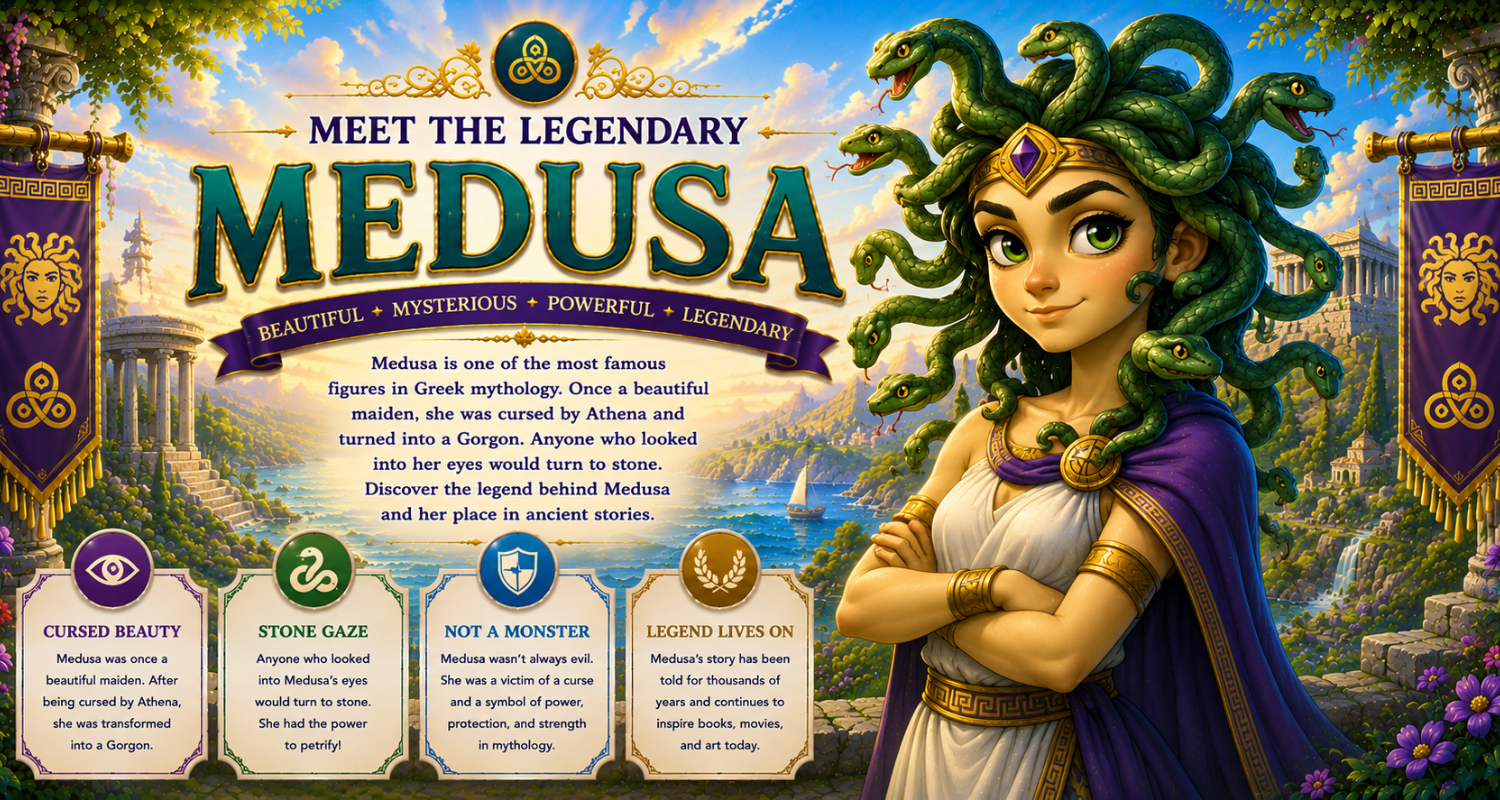
Meet the Legendary Medusa — Greek mythology Gorgon hero banner

Medusa: Facts, Powers, Legends, and Mythology

Guide

What Is Medusa?

Medusa is a legendary Gorgon from Ancient Greek mythology, famous for having living snakes instead of hair and a magical gaze that could turn anyone into stone. Her story has fascinated people for more than 2,500 years.

In the oldest Greek stories, Medusa was one of three Gorgon sisters and the only one who could die. Later myths, especially those told by the Roman poet Ovid, describe her as a beautiful woman transformed into a Gorgon by the goddess Athena after a tragic event.

Although she is often portrayed as a monster, Medusa's story has been interpreted in many ways. Some see her as a dangerous creature, while others view her as a misunderstood figure whose legend represents justice, resilience, and transformation.

Medusa stands alongside the basilisk, the hydra, and the chimera as one of Greek mythology's most iconic creatures. Explore the full mythical creatures guide to discover more.

Quick Medusa Facts

Creature Type

Mythical Gorgon

Appearance

Woman with Living Snakes for Hair

Origin

Ancient Greek Mythology

Habitat

Remote Islands, Sacred Caves

Powers

Petrifying Gaze, Super Strength, Immortality (some legends)

Symbolism

Protection, Power, Transformation

Appearance

What Does Medusa Look Like?

Medusa is usually shown as a woman with living snakes instead of hair. Depending on the legend or artwork, she may appear beautiful, terrifying, or somewhere in between — making her one of mythology's most recognizable figures.

Snake Hair

Medusa's most famous feature — living snakes that move, hiss, and coil constantly, marking her transformation into a Gorgon.

Petrifying Eyes

Medusa's eyes carry incredible supernatural power. Anyone who looks directly into them instantly turns to stone.

Sharp Fangs

Many ancient artworks show Medusa with pointed fangs that emphasize her dangerous, otherworldly nature.

Scaly Skin

Some legends and artistic depictions give Medusa patches of green or bronze-colored scales to highlight her serpent connection.

Serpentine Features

Depending on the version of the myth, Medusa may also have claw-like hands or a forked tongue inspired by snakes.

Human Form

Despite her Gorgon features, Medusa retains a human-like body — described as graceful, regal, and unmistakably powerful.

Green Medusa

Green skin is one of the most common modern portrayals, reflecting her close connection to snakes and nature.

Black-Haired Medusa

Some ancient artwork depicts Medusa with dark hair before it transformed into living serpents.

Golden-Haired Medusa

Later Greek myths describe Medusa as a beautiful woman with long golden hair before Athena's curse.

Stone Gray Medusa

Modern fantasy sometimes portrays Medusa with gray skin that reflects the stone-like curse she carries.

How Tall Is Medusa?

Most Greek legends describe Medusa as being about the same height as an ordinary woman — standing between 5 and 6 feet (1.5 to 1.8 meters) tall. Although her size is human, her supernatural powers make her one of the most feared creatures in mythology.

Powers

Medusa's Powers

Medusa is one of the most powerful creatures in Greek mythology — combining a deadly petrifying gaze, supernatural strength, snake hair, and incredible senses.

Petrifying Gaze

Medusa's most famous power — anyone who looks directly into her eyes instantly turns into solid stone.

Snake Hair

Living snakes grow from her head, hissing and striking at enemies who come too close.

Super Strength

Though she appears human, Medusa is far stronger than ordinary mortals — easily defending herself in the wilderness.

Keen Senses

Medusa's heightened hearing and eyesight help her detect approaching enemies long before they reach her home.

Agility

Despite the snakes covering her head, Medusa moves quickly and gracefully across rocky landscapes.

Fearsome Presence

Even before anyone meets her gaze, Medusa's terrifying appearance inspires fear in heroes and monsters alike.

Mythology

Medusa Mythology & The Story of Perseus

From the three Gorgon sisters to the legendary hero Perseus and his mirrored shield, Medusa's myth is one of the greatest adventures in Greek mythology.

The Three Gorgons

Medusa was one of three Gorgon sisters. Her sisters Stheno and Euryale were immortal, while Medusa was the only Gorgon who could die.

Daughter of Phorcys and Ceto

In the earliest Greek traditions, Medusa was born a Gorgon — daughter of ancient sea deities Phorcys and Ceto.

Athena's Curse

The Roman poet Ovid told a different version: Medusa was once a beautiful young woman before being transformed by Athena as punishment.

Perseus's Quest

The hero Perseus was sent on a dangerous mission to defeat Medusa and bring back her head — one of the greatest adventures in Greek myth.

The Mirrored Shield

Athena gave Perseus a polished bronze shield. By watching Medusa's reflection instead of her face, Perseus approached safely.

Medusa's Defeat

Perseus defeated Medusa in her sleep. Even after death, her head retained its petrifying power and was placed on Athena's shield.

Roman Adaptations

Roman artists frequently included Medusa in mosaics, sculptures, jewelry, and architecture as a recognizable symbol carried over from Greek myth.

Modern Mythology

Medusa continues to inspire storytellers today — appearing in books, movies, television, and video games around the world.

Why Does Medusa Have Snake Hair?

In the best-known version of the legend, Medusa was once a beautiful woman with long golden hair. After a tragic event involving the sea god Poseidon inside Athena's temple, the goddess Athena transformed Medusa into a Gorgon. Her hair became a nest of living snakes, and her gaze gained the power to turn others into stone.

Earlier Greek myths tell a different story — Medusa was simply born as one of the three Gorgons and always had snakes for hair. Many historians believe the snakes symbolize danger, transformation, and divine power, combining ancient Greek ideas about rebirth, wisdom, and protection into one unforgettable figure.

Home & Symbolism

Where Medusa Lives & What She Means

Medusa's Habitat

Remote Islands

Many Greek stories place Medusa on a distant island at the edge of the known world, far from civilization.

Sacred Caves

Caves appear frequently in artwork as Medusa's shelter — dark and secluded among rocky landscapes.

Rocky Cliffs

Steep cliffs overlooking the sea form a dramatic setting where heroes struggle to approach the Gorgon's lair.

Ancient Wilderness

Medusa belonged to the wild — untouched forests, barren hills, and remote landscapes beyond the reach of ordinary people.

Symbolism

Protection

Medusa's face, known as the Gorgoneion, was placed on shields, temples, and armor to ward off evil and danger.

Power

Her petrifying gaze symbolizes immense supernatural power — feared by gods, heroes, and monsters alike.

Transformation

From beautiful maiden to Gorgon, Medusa's story symbolizes dramatic change, rebirth, and identity.

Justice & Resilience

Modern interpretations view Medusa as a symbol of resilience, justice, and surviving against unfair circumstances.

Mystery

Hidden caves, distant islands, and supernatural abilities make Medusa a lasting symbol of mystery.

The Divine Feminine

Medusa has become an icon of feminine strength — reclaimed by artists and storytellers as a figure of power, not shame.

Legendary

Famous Medusas in Stories & Culture

From ancient Greek temples to Clash of the Titans, Percy Jackson, God of War, and the Versace logo — Medusa has inspired storytellers and artists for thousands of years.

The Original Greek Medusa

The legendary Gorgon of ancient Greek mythology — daughter of Phorcys and Ceto, defeated by Perseus and immortalized on Athena's shield.

Clash of the Titans

Both the 1981 classic and the 2010 remake portray Medusa as a deadly monster guarding an ancient temple — one of her most famous modern appearances.

Percy Jackson Series

Rick Riordan's bestselling series reimagines Medusa as one of the first monsters Percy encounters, introducing her to a new generation of young readers.

Dungeons & Dragons

The popular tabletop role-playing game includes Medusas as powerful monsters whose petrifying gaze makes them among the most dangerous opponents.

God of War

The God of War video game series features Medusa-inspired Gorgon enemies that retain her classic abilities, including the deadly stone gaze.

Assassin's Creed Odyssey

Players encounter Medusa as a legendary creature, blending classical Greek mythology with action-adventure gameplay.

Versace Logo

The famous fashion house Versace uses Medusa's head as its iconic emblem — symbolizing beauty, power, and the inability to look away.

Caravaggio's Medusa

The Italian Renaissance master painted one of the most famous artistic depictions of Medusa — capturing the moment Perseus defeated her.

For Kids

Fun Medusa Facts

  • 1Medusa comes from Greek mythology.
  • 2She had living snakes instead of hair.
  • 3Looking into Medusa's eyes could turn people to stone.
  • 4Perseus defeated Medusa using a mirrored shield.
  • 5Medusa is one of the three Gorgons.
  • 6She was the only mortal Gorgon.
  • 7Her sisters were Stheno and Euryale.
  • 8Medusa appears in many ancient Greek stories.
  • 9Athena helped Perseus on his quest.
  • 10Hermes gave Perseus magical winged sandals.
  • 11Medusa's home was far from cities.
  • 12Ancient Greeks used Medusa's face as protection.
  • 13Her image was called a Gorgoneion.
  • 14Snakes are her most famous feature.
  • 15She remains popular in modern fantasy.
  • 16Medusa appears in movies and books.
  • 17She is featured in many video games.
  • 18Ancient artists often carved her face into temples.
  • 19Medusa symbolizes transformation.
  • 20She also represents strength and protection.
  • 21Her story is over 2,500 years old.
  • 22No scientific proof of Medusa exists.
  • 23She is one of the world's most famous mythical creatures.
  • 24Her legend continues to inspire artists.
  • 25Medusa remains one of Greek mythology's greatest icons.

FAQ

Frequently Asked Questions

SevenCreatures logo

Reviewed by Sevyn's Creature Team

SevenCreatures creates fun, kid-friendly educational content about animals, dinosaurs, sea creatures, and mythical creatures. Our mission is to help kids explore the amazing creatures of our world through facts, quizzes, coloring pages, and stories.